Governor Baker recently introduced to the public his picks for appointment to the Massachusetts Supreme Judicial Court. In a recent article by Lawyers Weekly a number individuals from the local legal community, including CPCS Chief Counsel Anthony Benedetti, commented on the Governor’s nominees. To read the article, please see below:
Lawyers Weekly
Baker’s SJC picks draw widespread praise
By: Kris Olson and Patrick Murphy June 16, 2016
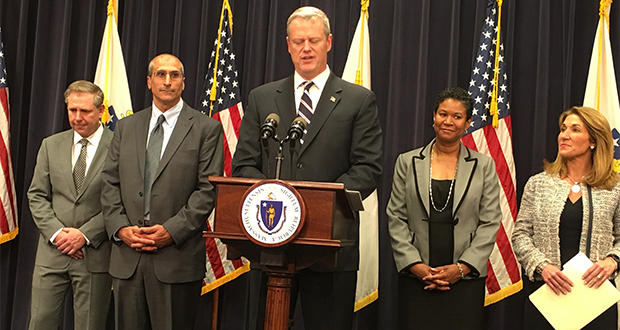
If the reception from local bar leaders to Gov. Charlie Baker’s three nominees to the Supreme Judicial Court is any indication, their trip before the Governor’s Council for confirmation should be a breeze.
Baker’s selection of Superior Court Judges Kimberly S. Budd, Frank M. Gaziano and David A. Lowy drew widespread praise for their intelligence, knowledge of the law and comportment in the courtroom. While it was noted that all three at one point in their careers had been prosecutors, that did little to dampen the enthusiasm of even the criminal defense bar’s assessment of Baker’s choices.
The only other quibble with the governor’s picks was related to a lack of geographic diversity among the three nominees, as Budd, from Newton, Gaziano, from Scituate, and Lowy, from Marblehead, all live east of Route 95.
But Baker was quick to point out that the forthcoming retirements of SJC Justices Francis X. Spina, Robert J. Cordy and Fernande R.V. Duffly are merely the first three of five vacancies he will have to fill, with Justice Margot G. Botsford hitting the mandatory retirement age of 70 on March 16, 2017, and Justice Geraldine S. Hines following suit on Oct. 29, 2017.
Beyond that, however, concerns were few and far between.
In his prepared remarks at the June 15 State House ceremony introducing the three nominees, Baker was the first of many to tout the “measured, fair temperament” and “outstanding legal knowledge” of the nominees, whom he noted would be charged with upholding a legacy for prudent decision making, which dates back to 1780.
Baker estimated that the screening committee had received between 40 and 50 applications for the three anticipated vacancies.
Lowy has been on the bench since 1997, first in District Court. He then moved to Superior Court in 2001 upon being nominated by Gov. A. Paul Cellucci. He had stints with both the Suffolk and Essex County District Attorney’s Offices, including in the Suffolk gang unit. He also worked under Gov. William F. Weld and Cellucci as deputy legal counsel from 1992 to 1995.
He began his legal career as an associate at Goodwin Procter and also clerked for U.S. District Court Judge Edward F. Harrington.
Budd, a former assistant U.S. attorney, was appointed to the Superior Court by Gov. Deval L. Patrick in 2009. Budd had spent the previous five years serving as director of the Community Values program at Harvard Business School.
Gaziano was appointed to the Superior Court in 2004 by Gov. Mitt Romney. He was a Plymouth County assistant district attorney for 10 years before serving as an assistant U.S. attorney in Boston from 2001 to 2004.
Retired Superior Court Judge Howard J. Whitehead, who first met Lowy as an Essex County assistant DA, reconnected with him when they were the two primary judges in Superior Court in Salem. He said he and Lowy were “like twins,” who thought alike and had the same job.
“Dave would probably say I was his mentor, but I’m not sure; eventually, he became my mentor,” Whitehead said, highlighting Lowy’s “incredible intellectual and physical energy.”
Despite his professional success, Lowy has never lost sight of his roots, Whitehead said, noting that Lowy’s inner circle still includes his friends from Peabody High School. Whitehead added that Lowy also is ever mindful of his family’s struggles to establish themselves as immigrants from Eastern Europe, something Lowy mentioned in his remarks upon being introduced by Baker at the State House ceremony.
Friend and Chelsea defense attorney Randy S. Chapman said that Lowy is universally viewed by litigants on both sides of the aisle as “extremely hard-working, very fair and knowledgeable.”
“He’s somebody who takes the time to go the extra yard to understand every argument and reach a thoughtful, scholarly decision,” Chapman said.
While presiding over the trial of Philip D. Chism, who was convicted of murdering Danvers High School teacher Colleen Ritzer, might have been Lowy’s most publicized recent case, he noted that even more challenging may have been the proceedings related to the murder of Ipswich restaurant owner Shui Keung “Tony” Woo, which lasted for months and presented serious language barriers, requiring the services of multiple interpreters.
Both Whitehead and Chapman said that Lowy “wrote the book” on evidence in Massachusetts, a subject on which he teaches at local law schools and bar programs.
Boston Bar Association President-Elect Carol A. Starkey noted that the BBA has had positive experiences with each of the nominees, but perhaps none more so than with Budd, who has served on the Boston Bar Council and the board of editors for the Boston Bar Journal.
Starkey described Budd as a “steadfastly engaged supporter and volunteer” and a “person filled with integrity who is thoughtful and smart.”
Martin W. Healy, general counsel and chief operating officer of the Massachusetts Bar Association, who was a year ahead of Gaziano at Suffolk University Law School, said Gaziano had made his mark at the school academically, serving as an editor and member of the Suffolk Law Review and graduating second in his class.
“He has been a very bright legal talent from law school on,” Healy said. “I’m not surprised he has done so well over the last 20 years.”
Healy predicted that Gaziano would quickly become a “go-to person” on the SJC regarding the rules of criminal practice.
Michael D. Riseberg, president of the Massachusetts Defense Lawyers Association, commended the nominees for their intellect and judicial temperament in an email to Lawyers Weekly.
While Riseberg was careful not to criticize the governor’s choices, he did point out that each of the nominees had backgrounds as criminal prosecutors.
“As an organization of civil defense attorneys, the MassDLA believes there is an equally important need for judges on the Massachusetts Supreme Judicial Court with a significant background in civil litigation,” Riseberg wrote. “That being said, the MassDLA believes these are all worthy nominees.”
Expressing similar thoughts was Committee for Public Counsel Services Chief Counsel Anthony J. Benedetti.
“I’ve heard very positive things from the defense bar, in terms of individual attorneys’ experiences [with the three nominees],” Benedetti said. “They found them to be fair, smart, thoughtful and respectful.”
“In a perfect world” it might be good to add a justice with a defense background to the SJC, Benedetti said. “That being said, these are impressive selections.”
Healy agreed that the three nominees’ experience as prosecutors was not much of an issue, noting that each has held a variety of positions, including in private practice and on the bench, since, and that their reputations as prosecutors were of being “fair, even-tempered” and not overly aggressive.
The importance of the temperament of each has become increasingly important, now that serving as an SJC justice entails much more than hearing oral arguments and writing opinions, Healy said.
“They are so much more involved in administrative functions, serving as liaisons to court departments and different entities and agencies the SJC controls,” he said.
Healy also cited a “certain call to public service” among all three nominees, who could have made a lot more money in the private sector.