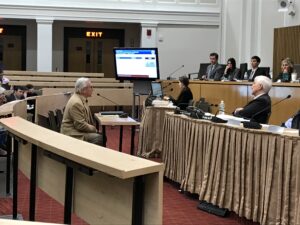
Director of CPCS Mental Health Litigation Division Mark Larsen Testifies before Joint Legislative Committee on Governor’s Care Act

Attorney Mark Larsen, Director of the CPCS Mental Health Litigation Division, testified on behalf of CPCS on January 16, 2018, before the Joint Committee on Mental Health and Substance Abuse, voicing CPCS’s concerns with the Governor’s Care Act legislation, H.4033 – An Act Relative to Combatting Addiction, Accessing Treatment, Reducing Prescriptions, and Enhancing Prevention.
Attorney Larsen told the Committee that there is no question that the use and misuse of opioids has resulted in a major health problem for Massachusetts and the entire country, and that H.4033 is meant to address various aspects of the opioid crisis. He qualified this statement, noting, “However, several provisions of the bill regarding the detention and transport of individuals for emergency assessment must be subject to close scrutiny with regard to due process, cost, and whether there is evidence to support the value of coerced treatment.”
He listed specific issues CPCS has with the legislation, such as allowing various clinical professionals or law enforcement to detain a person when they believe the failure to involuntarily commit him or her for treatment would create a likelihood of serious harm and restraining such person for an unspecified period while awaiting transport to “an appropriate treatment facility”, especially since it is not clear who will attempt to find the appropriate treatment facility or how the person is to be transported to the facility. Larsen also called attention to the fact that the bill sets no limit on how long a person can be detained pending admission to “an appropriate treatment facility” and does not establish a process for judicial review of this initial detention.
He continued, noting that the bill provides that once transported to a facility a person would be evaluated within 72 hours and that prior to this, the facility would be required to notify the person of his or her right to counsel. If the person requests counsel CPCS would be mandated to provide an attorney, which would result in substantial new costs. Larsen explained, “This will require CPCS to institute a process for monitoring such requests and for the immediate assignment of counsel.” He added, “In order to estimate this cost, we considered the more than 20,000 opioid-related EMS calls made in 2016, and while 2017 appears to have fewer such calls, if 50 percent of those detained request counsel, CPCS will see a significant increase in the assignment of counsel, [which] will necessitate having both staff to assign the cases and attorneys to accept the assignments.”
At the conclusion of his testimony, Atty. Larsen urged the Committee to look to treatment as the best way to address the opioid issue and to consider funding for treatment on demand, rather than funding for the provisions called for by H.4033. He said, “Considering the needs of our clients, treatment is essential. The evidence to support coerced treatment is equivocal, while the value of voluntary treatment is clear.”