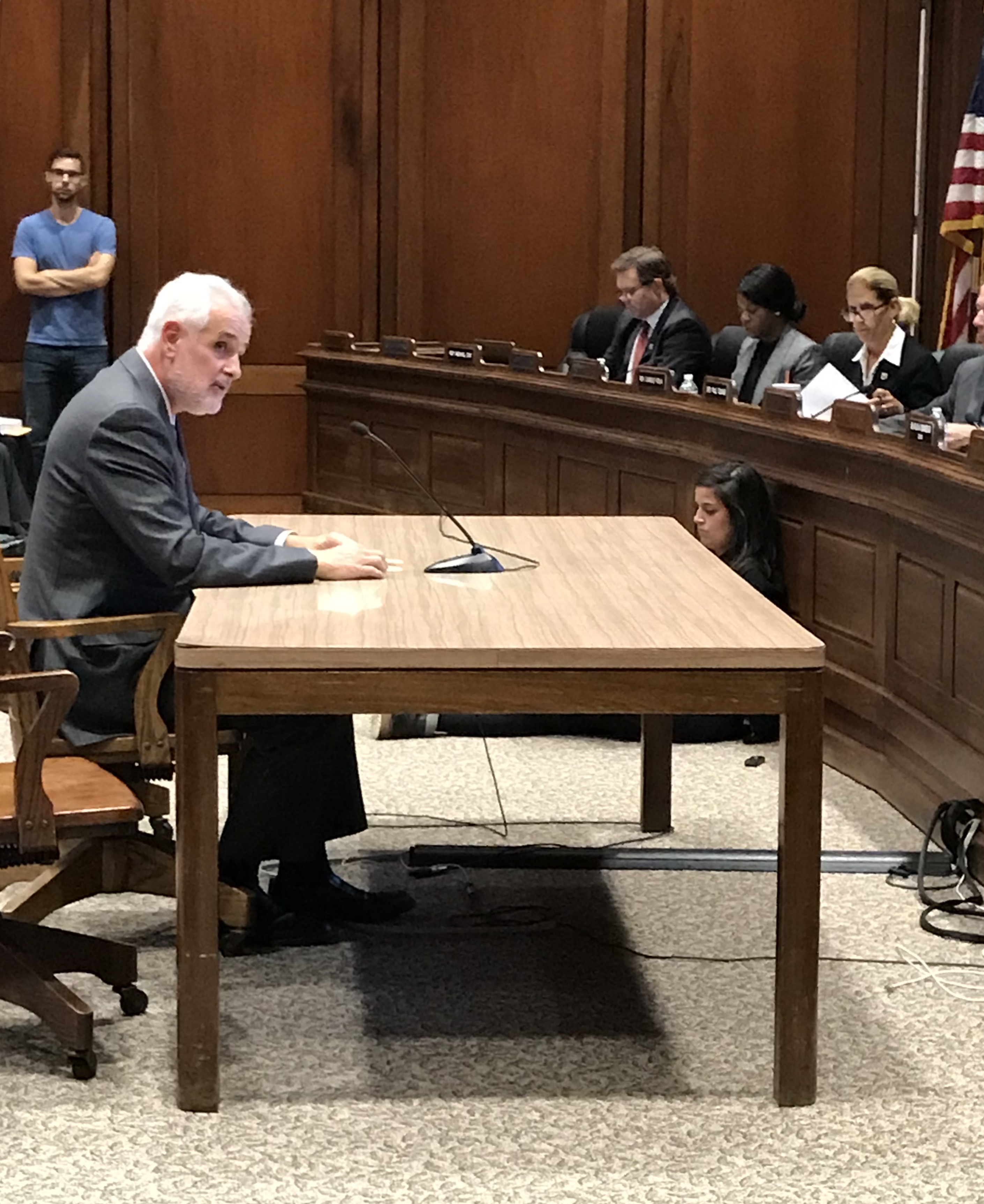
On October 16, 2017, CPCS Deputy Chief Counsel Randy Gioia testified on behalf of CPCS before the Joint Committee on the Judiciary in opposition to H.3671 – An Act Modernizing the Massachusetts Wire Tap Law, a bill filed by Governor Charlie Baker.
He urged the Committee to report the bill out unfavorably because, if enacted, it would lead to “a broad and unnecessary expansion of a powerful law enforcement tool: the ability to secretly intercept private communications between people, which has the potential to invade the private lives of multitudes of people not engaged in criminal activity.”
He continued, “There is no clear or compelling justification for such expanded law enforcement interception of private communications. I understand Justice Gants’ concern in the Tavares case that street gang murders may not come within the definition of organized crime…., but street gangs are organized criminal activity. We may just need to amend the definition of organized crime to include gangs that are organized, but not connected with a profit-making enterprise.”
In support of his argument, the deputy chief counsel cited Commonwealth v. Blood, in which the SJC recognized the unique privacy intrusion resulting from a wiretap, “[T]he instruments of electronic eavesdropping are peculiarly adapted to search our thoughts and emotions” and thus “are peculiarly intrusive upon that sense of personal security which art. 14 commands us to protect.” 400 Mass. 61, 70 (1987).
He explained further that the proposed bill would do away with many of the current law’s limitations and thereby would potentially violate the Massachusetts Constitution Article 14 right to be free from unreasonable searches. “At a minimum, these broad expansions on the ability of the government to intercept private communications will result in substantial litigation regarding the lawfulness of such broad wiretapping authority,” he concluded.