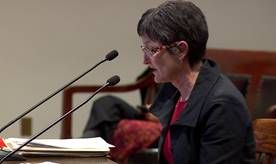
 On November 25, 2017, CPCS Attorney Larni Levi, Director of the CPCS Alternative Commitment & Registration Support Unit, testified on behalf of CPCS before the Joint Committee on the Judiciary in opposition to H.2300 – An Act Removing State Funded Counsel from Sex Offender Classification Hearings and H.3501 – An Act Relative to the Sex Offender Registry Board. Both bills would abolish the right to counsel for poor people at SORB hearings.
Attorney Levi testified that there are two major problems with the bills – one is constitutional and the other practical.
She explained that the constitutional issue involved due process, stating, “Appointed counsel for the poor is a critical due process protection under Article 12 of the Massachusetts Constitution. Due process means a fair hearing. A person who cannot read and understand 40 pages of SORB regulations; scientific articles and 38 SORB factors; and does not understand “evaluative reports and empirically-based risk assessment instruments” cannot get a fair hearing. Given the SJC’s recent decision raising the burden of proof to clear and convincing evidence, the constitutional basis for appointed counsel is stronger than ever. Doe 380316 v. SORB, 473 Mass. 297 (2015)”.
She then outlined for the Committee the practical matters of what happens when a poor person does not have counsel at these hearings:
- Hearing before the board where registrant represents himself; doesn’t present evidence; doesn’t understand what is happening to him.
- When Superior Court reviews this record – the Superior Court doesn’t want unrepresented litigants. Litigation takes longer, creates more work for the court.
- Superior Court reviews record, finds hearing not fair—remands it to SORB.
- Board will be inundated with new hearings.
- More new hearings cause unnecessary expenditure of time and resources to rehear cases and correct errors.
- Pro se litigation
- Means more people being over-classified.
- Means longer lines at police stations when people who are really low risk are erroneously classified as level 2 or 3 and have to register in person at police stations.
- Means diverting police resources from important public safety efforts to registering low risk offenders.
- RESULT: NOT in anyone’s best interest.
Atty. Levi also encouraged the Committee to consider favorably H.2324 – An Act Amending the Sex Offender Registry Statute to Require Immediate Registration of Sex Offenders, which was requested by CPCS. It eliminates the problem persons convicted of a sexual offense are running into in locations such as Boston where they are being asked at local police stations to make appointments to register. The legislation would make it mandatory that police register sex offenders immediately. Now, the many who try to register are, through no fault of their own, in violation of existing law and subject to sanctions.
Before concluding, she presented the written testimony of two other individuals in support of bills requested by CPCS, H.3066 – An Act Relative to Juveniles Accused of Sexual Offenses and H.3583 – An Act Removing Youthful Offenders and Juveniles from the Definition of Sex Offender:
- The testimony of Fred Smith, who is the retired Program Director of St. Francis House, a large day shelter in downtown Boston, profiled clients from suburban middle-class backgrounds whose lives were destroyed after they were placed on the sex offender registry for statutory rape convictions—consensual sex with girlfriends, which resulted in their substance abuse, unemployment, and homelessness.
- In her testimony, Andrea Casanova of the Ally Foundation, which was created in memory of her daughter who was murdered by a repeat sex offender, explained that the offender was in the community because of loopholes in the law, which also resulted in his being untreated and unsupervised. She urged the Committee to consider evidenced-based research in differentiating adult sex offenders from adolescents and children.
Attorney Levi closed by informing the Committee that CPCS would be submitting written testimony at a later date on a number of other bills being heard by the Committee that day.