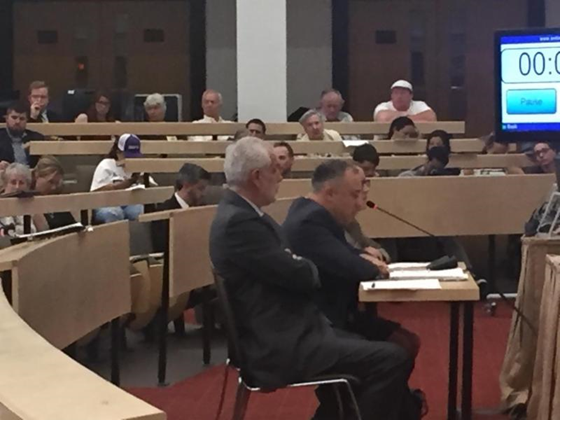
On June 19, 2017, before a large audience in Gardner Auditorium at the State House, a panel consisting of Committee for Public Counsel Services (CPCS) Chief Counsel Anthony Benedetti, Deputy Chief Counsel of the CPCS Private Division Nancy Bennett, and Deputy Chief Counsel of the CPCS Public Division Randy Gioia testified on behalf of CPCS before the Joint Committee on the Judiciary.
The Committee heard testimony on a number of bills, among them H.74 – An Act Implementing the Joint Recommendations of the Massachusetts Criminal Justice Review [the Counsel of State Governments (CSG) bill] and H.741, H.820, H.989, and S.819 – Acts Eliminating Mandatory Minimum Sentences for Drug Offenses. The panel led by Chief Counsel Benedetti supported H.74, but expressed concern with the bill, as drafted. The CPCS panel urged the Committee to consider amendments to the bill that would address certain constitutional concerns posing Article 30 and due process issues. They also suggested the bill be amended to create greater incentives for prisoners to participate in rehabilitative programming, that incentives provided by the bill be available to all people serving time for opioid-distribution offenses so that it would significantly impact reduction in recidivism, and that certain language be redrafted to remove impediments that would make it extremely difficult for attorneys to provide clients with sound advice.
As for the panel’s testimony supporting the bills eliminating mandatory minimums, the chief counsel concentrated a portion of his presentation on refuting testimony given by a panel of District Attorneys. He and Deputy Chief Counsels Bennett and Gioia provided evidence of why mandatory minimums are a failed policy. They spoke against such sentences explaining that they do not deter offenders, do nothing to reduce crime, fail in aiding those dependent on substance use, are ineffective in providing uniform sentencing, and do not preserve appropriate sentencing discretion.
The CPCS panel applauded the work of the CSG, Governor, Senate President, Speaker of the House, and Chief Justice of the Supreme Judicial Court in promoting criminal justice reform, but they urged the Committee to act favorably on more than just H.74, stressing that the Commonwealth has a genuine opportunity to make impactful criminal justice reform and suggesting that eliminating mandatory minimum sentences for drug offenses would provide the perfect complement to the CSG bill.